
Lifelong dream ready for takeoff
By Walt Wiley, Bee Staff Writer
The Sacramento Bee, Thursday, November 30, 1995
article also available in
pdf format (391 KB)
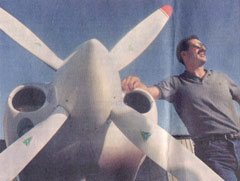 Brent
Regan always wanted to fly his own plane, ever since he was a teen and
his older brother bought a little Cessna and let him handle the controls.
Brent
Regan always wanted to fly his own plane, ever since he was a teen and
his older brother bought a little Cessna and let him handle the controls.
The trouble was, three years ago when Regan finally had the wherewithal and time to allow him to fly, there didn't seem to be any airplanes around that were much more advanced than that little Cessna of two decades ago.
So Regan built his own.
"I am kind of proud of the way it's turned out," said Regan one recent afternoon as he leaned against the gleaming white wing of experimental aircraft No. N170BR on the apron of the Yolo county airport near Davis.
There was more than a hint of delight in his voice.
No. N170BR, or "Bravo Romeo" in airplane parlance, stood up on its spindly landing gear like some shore bird with an attitude.
The airplane is a Lancair IV-P, built from a kit made by an Oregon firm and designed to be glued together, much as plastic model airplanes are glued together.
It actually is plastic, after a fashion - a composite of carbon fibers and resins. It bears the "experimental" designation because it is built from a kit, not made on a factory production line.
"it's what you have to do if you want an airplane that can do anything like what is possible today," said Regan. "The factory planes just aren't this advanced."
He explained that advanced, to him, is an 1,800-pound airplane that cruises at 310 mph 25,000 feet above Earth using less than 20 gallons of gasoline per hour with four passengers in a pressurized cabin - all of which his plane will do. It flies twice as high and 100 mph faster than any factory plane anywhere near like it, he said.
From his home in Davis, Regan said, he can be at the airport and have the plane checked out and ready to fly in 15 minutes.
"After that, I'm 24 minutes from San Jose. Los Angeles is an hour and 15 minutes away and Denver is less that three hours."
Regan, 37, is a tall, brawny mechanical engineer who learned to be handy with tools starting at age 7, he said, in his father's Redwood City machine shop, a place that pulsated with magical energy for a boy.
"Over the years, Dad made all sorts of stuff for the aerospace industry. There's stuff on the moon from his shop and stuff in the Smithsonian. That place was amazing. Prepared me for where I am."
Regan moved to Davis in 1986, when he was one of the co-founders of Schilling Development Co., the firm that makes robot arms for science and industry to use in environments unsafe for humans.
He and his partners sold out three years ago, and it was then that Regan began the airplane project.
"I still worked 50 hours a week at Schilling," he recalled. "But I built a shop right next to the house, fixed it up nice so I could work in there in the evenings."
So confident was Regan that he was on the right path that he plunked down $22,000 for the kit to build the airplane's wings before even signing up for flying lessons.
And then he went to work. He spent another $46,000 on other kit subassemblies, $50,000 for an engine, $10,000 for a propeller and $37,000 for instruments.
And then there is the small matter of 4,943 hours of construction time logged on the project by Regan, plus another 97 hours logged by the painter and the technician who installed the extensive radio system.
As Regan stood by the plane, it was all but complete. Still to be done was the leather upholstery and the fitting of another piece of electronic wizardry into one remaining gaping hole in the instrument panel - as soon as he decides what he wants.
As it is, the airplane looks gleaming and flawless, stark white with a black stripe and a shadow underneath of "rose mica metallic," a color from the official Toyota factory palette.
"There are 25 of those planes flying now, and I'd say his is the nicest yet," said Don Goetz, Lancair's chief pilot and a man who has flown all the kit planes that have been completed.
He said there are 325 more of the planes in various stages short of completion.
Lancair, in Redmond, Ore., has kits for five different aircraft, Geotz said, with perhaps 1,400 kits sold and a total of some 400 actually flying. Company officials say the selling point is the plane's advanced flying features, particularly its speed.
"Anything as fast as the Lancair is going to be a turboprop and it's going to be a million-dollar airplane or more," said Mike Schrader, the company's marketing director.
But how about the fact that Regan's plane is home-built instead of factory-made?
"My sister and I had a long talk about that," Regan said. "She decided that every airplane is made by someone, so it's probably better to have an airplane made by someone who knows he's going to fly it.
"That's me."