
Plug 'er in and Fill 'er up
Cover story, The Times Weekend Section (San Mateo, CA), Saturday, Oct.
1, 1977
article also available in
pdf format (1.2MB)
 The
electroframmis is conjugrated to the retroblix.
The
electroframmis is conjugrated to the retroblix.
Which in turn maneuverablizes the conwich. Thus when the hendleator is actimated, the thing runs.
Especially if someone remembered to plug in the transitizer.
At least that's what it sounds like when Brent Regan attempts to explain his contribution to the energy conservation cause to a listener who thinks of horsepower as something fueled by had with a topping of oats.
"It" is a vehicle that sort of look like Brent forgot his left Adidas when he unwinds all 6 feet 4 from behind the wheel and steps out.
It's a near-vintage (1967) Fiat roadster that the builder has restored to pristine shiny smoothness. But it's what's under the bonnet that counts.
Young (19) regan has transformed the tiny hulk into an energy-miser electric runabout. it was a job he took on commission and worked at over the last half year while attending classes at College of San Mateo. The owner and financial backer of the project is Dr. Richard C. Thompson, who plans to use "Plug in" on his rounds from San Mateo home to office to hospital.
The builder says his electric conversion car is more than adequate for that kind of usage. It's maneuverable, cheap to operate and a lot more comfortable than a moped. But it's admittedly not a power package that east up hills and wins drag starts. The sporty little battery model is best suited to town driving - in a town where there aren't too many hills.
The economics: electricity for recharges every 40 to 50 miles works out to a cost of about 1 1/2 cents per mile (against about 8 cents a mile for a gasoline engine vehicle). Figuring the cost of replacement batteries every 10,000 to 15,000 miles, the cost per mile goes to about 3 cents.
The basic motive power involves ten 6 volt heavy duty batteries connected in series to give a 60 volt power output to the motor, which is an aircraft starter generator.
Six of the batteries are arranged in the rear compartment where the Fiat's original motor and gasoline tank once lived. A fire wall, unnecessary since there's no more of the inflammable fuel around, also was removed. The other four batteries are installed in the front luggage compartment.
But since the runabout has an effective range of only 50 miles at a top speed of 55mpg, it's not meant for excursions that might call for suitcases and sports gear.
The motor is connected to a plate and the plate is connected to a standard Fiat drive train, and it's all done by the virtue of what Regan describes as "solid state technology that just didn't exist more than two years ago."
That's when the hayburner-era interviewer retreats to a subject more familiar: the element that makes the overgrown tennis shoe with the "Plug IN" license plate move.
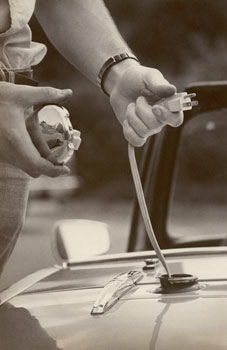
That is literally a plug. An electric plug that appears on a length of cord from under the cap where the gasoline nozzle used to fill 'er up before the world recognized that fuel oil was not an inexhaustible commodity.
Works on any 110 volt outlet. Best to recharge when it's about half empty, an eight-hour - overnight - process.
Dr. Thompson's electric conversion car is one of perhaps 50 in the bay area. There's even a club for their owners, who get together for rallyes and conversation.
Regan says that Volkswagens are popular subjects for electrification, and the group includes HIllmans, Renaults, even dune buggies. The motor-in-the-rear configuration is considered best for conversion.
There are even some luxury sedans, and Regan cites the showpiece of electric automobility owned by television star Lloyd Bridges as an example.
As for comfort, Brent notes that the Fiat has plenty of leg room even for a tall fellow like himself. Since there's no engine, it doesn't have a heater, but enough air blows over the solid state control in the rear compartment to "take off the chill on a cold day."
And, of course, there's never any problem with starting up on a frosty morning.
With the 6 volt, 217 ampere hour lead acid batteries installed (at 66 pounds apiece) the Fiat has gained 500 pounds over its original weight. But the rebuilder found no need to modify the suspension, and it still can handle two people.
At 19 REgan is a veteran of the electronics age. As a little kid in Hillsborough he astounded his schoolmates with the products of his workshop - including a robot that caused quite a few grownup jaws to drop when it made the rounds on Halloween.
Now Brent will be taking more formal classes in electronics at Cal State Poly/San Luis Obispo. But he has offered to give brief technical data to any readers who are seriously interested in the subject of electric auto conversions. He does his very sophisticated tinkering at his father's manufacturing firm, Dynatex of Redwood City, and can be reached there by leaving a message.
"Plug In" is not young Regan's first electric vehicle. That came when he was about eight years old as a result of stubborn determination to prove dad Barrie Regan's "It can't possibly be done" the words of a badly misinformed adult.
He did, and the battery-powered go-cart that he put together in secret actually ran. Only thing it ran BACKWARDS!
Over the past dozen years, Brent has improved on that situation.
J.B.